VISIT OUR WEBSITE AT www.SEAChangeHappen.org
To be notified of future blog posts, sign up for e-mail alerts!!
Enter your Email:

Friday, October 12, 2007

Honoring progressive leadership

Today the "former next President of the United States" joined such great leaders as the 14th Dalai Lama, Elie Wiesel, Desmond Tutu, Mother Teresa, and Martin Luther King, Jr as this year's winner of the Nobel Peace Prize. Albert Arnold (Al) Gore, Jr., along with the UN's Intergovernmental Panel on Climate Change (IPCC), was awarded the prize for "efforts to build up and disseminate greater knowledge about man-made climate change, and to lay the foundations for the measures that are needed to counteract such change."

Al Gore is not the first "politician" to win the Peace Prize; far from it, as many of the winners have been U.S. and world politicians. What is notable for me, in light of the direction this country has taken in the past three decades, and most dramatically since Bush's "election", is that only two Republicans have been awarded this most important honor. And of the two, only Henry Kissinger (1973) could be considered a Republican in the modern sense of the GOP. The other, President Theodore Roosevelt, was a progressive reformer who endeavored to move the Republican party into the Progressive movement. This put T.R. into the same company as his cousin F. D. R. and solidly into modern liberal territory. (I purposly say "liberal" and not "Democratic". The U.S. ideology has shifted right since Reagan to the point where very few Democratic politicians, at least in Federal government, represent the traditionally diverse, liberal issues espoused by the Democrats in the past.)

[P]rogressivism made great strides under American presidents Theodore Roosevelt, William H. Taft, Woodrow Wilson, and Franklin Delano Roosevelt.

Progressivism historically advocates the advancement of workers' rights and social justice. The progressives were early proponents of anti-trust laws and the regulation of large corporations and monopolies, as well as government-funded environmentalism and the creation of National Parks and Wildlife Refuges.


"Old-school" Democrats are well represented in the Peace Prize, with Presidents Jimmy Carter and Woodrow Wilson, 2002 and 1919, respectively, and George Marshall, originator of the Marshall Plan winning in 1953. Most striking, however, is the realization that post-Goldwater Republicans, the so-called conservatives of today, consider peace and promoting peace a sign of weakness. (Today's conservatives are better termed "neoconservatives" with all the justly deserved negative connotations associated with the label "neocon".)

As with all dark periods in world history, this too will end. I can't help but feel that Mr. Gore's Nobel Prize is yet another sign that the Reagan legacy is losing strength and that true progressive ideas will soon take root. Republican Senators are retiring en masse, the Democratic party is millions of dollars ahead of the GOP in fundraising, and concepts like global warming, alternative energy, increasing fuel economy, and reducing consumption are being discussed by more and more people.

We may yet survive. . .


(Okay, I derailed my Nobel Peace Prize essay and turned it into a political statement. That happens. To read more about this year's award see the story at the BBC News website.)

Wednesday, October 03, 2007

Think globally, generate locally.


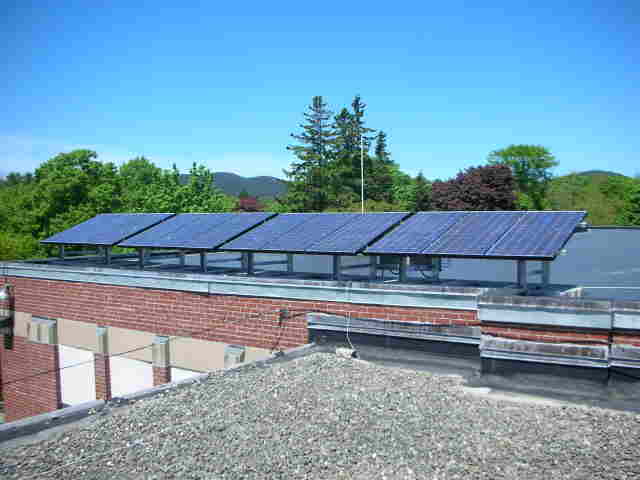
We hear more and more in popular culture and the media about generating electricity with photovoltaic (PV) solar panels, but relatively few people have actually seen this technology in action. Two Kennebunk, Maine women received some good news this week that will give local residents something to see, and hopefully talk about, on the subject of solar power.

A group of citizens, teachers, and school district administrators and operations staff in Kennebunk formed an Energy Advisory Committee (EAC) eighteen months ago to address energy, recycling, and other sustainability topics in the Maine School Administrative District 71 facilities in Kennebunk and Kennebunkport. (The idea for our group, SEA, was germinated in that group.)

This group has enjoyed tremendous success, attaining Energy Star certification for the 2.5 year old Kennebunk Elementary School, achieving impressive electricity and heating fuel savings across the school district, and driving a sharp reduction in trash through an innovative composting program implemented at the beginning of the current school year.

As I alluded to earlier, two members of the EAC have achieved yet another notable milestone in the local efforts to slow global warming. Jennifer Neise and Sassy Smallman raised seed money and applied for a Maine Public Utilities Commission grant to install a PV array at the Middle School of the Kennebunks. Neise was notified this week that the EAC was awarded this grant, and that installation of the 5.6 kW photovoltaic array can proceed.

The energy data from the array will most likely be available online, and the panels will tentatively be installed where they are prominently visible to the public. I would suggest that a placard be installed to direct people to sources of information about PV specifically and alternative energy in general to maximize the educational potential of the installation.

When people start to see concrete action taken at the local level, they will begin to realize that individual, incremental progress can be made in combating serious environmental issues.

On the web:
Middle School of the Kennebunks
Pemetic Elementary School, Southwest Harbor, Maine online PV reporting system

This graph is from Pemetic's PV array:


Here's what Pemetic's array looks like:

Wednesday, July 11, 2007

New Weapons From NewScientist To Fight Against Skeptics

If you have questions about some of the "controversy" about climate change or you are having trouble rebutting the assertions of a Global Warming Skeptic, then the NewScientist website has a new tool for you.

They write: "With so much at stake, it is right that climate science is subjected to the most intense scrutiny. What does not help is for the real issues to be muddied by discredited arguments or wild theories... So for those who are not sure what to believe, here is our round-up of the 26 most common climate myths and misconceptions."

My favorites:
Overall, it is a good resource.. Click here to read it from the New Scientist website.

Thursday, July 05, 2007

Climate Counts Holds Companies Accountable

Gary Hirshberg of Stoneyfield Farm has teamed up with the folks at Clean Air-Cool Planet "to bring consumers and companies together in the fight against global climate change." With their Climate Counts effort, their goal is "to motivate deeper awareness among consumers-not only that the issue of climate change demands their attention, but also that they have the power to support companies that take climate change seriously - and avoid those that don't."

It sounds so simple... Support companies who prove that they care about the future of humankind by taking concrete efforts to reduce their carbon footprint. But, getting that information is not very easy. That is where Climate Counts comes in.

This partnership has created a scorecard to "see how serious companies are about stopping climate change - and how they compare to their sector competitors." With this type of scorecard, consumers can make informed decisions to "vote with their wallets" to support companies who take a progressive stand about climate change.

The sectors scored are Apparel/Accessories, Beverages-Beer, Electronics, Food Products, Food Services, Household Products, Internet/Software, and Media. To rate companies, a total of 22 questions are asked like: Is a Green House Gas emissions inventory completed?; Has the company achieved emissions reductions?; and Is the company publicly reporting emissions? Click here to see a complete list of report questions.

As an example, here are the scores for the Apparel/Accessories category:

Company Score Company Score
Nike 73 Gap Inc. 39
Liz Claiborne 15 Limited Brands 05
VF Corporation 02 Levi Strauss 01
Jones Apparel Group 00

With all of the bad press that Nike gets about sweatshops making Air Jordan's, it is nice to see that they are leading the way on climate change. Levi Strauss... not so much. Guess what brand I won't be buying the next time I shop for jeans. Click here to see all of the categories - and to print out a handy pocket-sized version to keep in your wallet.

As consumers, we have an amazing amount of power over the corporations who are responsible for so much of the carbon footprint of our society. To be effective, though, we need more information like what has been gathered by the Climate Counts people. Let's hope that this is just the beginning of the public accountability of corporations. In the meantime, use whatever information is available to make informed choices when you buy! Your purchases make a difference.

Sunday, June 24, 2007

Use Blackle Instead of Google To Save Energy

NOTE ADDED 6/25 - Apparently the energy savings is only good on old-fashioned CRT screens, not LCDs... There seems to be some controvery here. Interesting idea, though!

I stumbled across a blog posting about a new site that uses Google to search the Internet except that it has a black back ground instead of the familiar white background. The premise is that a black background uses less energy on a monitor than a white background.

This is from the Blackle website:

"In January 2007 a blog post titled Black Google Would Save 750 Megawatt-hours a Year proposed the theory that a black version of the Google search engine would save a fair bit of energy due to the popularity of the search engine. Since then there has been skepticism about the significance of the energy savings that can be achieved and the cost in terms of readability of black web pages."
Using the premise that every little bit helps - give it a try! Save some energy whenever you Google. The search results are from Google, so you really have nothing to lose!

www.blackle.com

Reconnect To The Food That You Eat

I have blogged before about the important part that food choices make in the fight against climate change. With more and more food being shipped from across the country and around the world, the global warming pollution emitted to provide us with the foods that we eat significantly contributes to our carbon footprint.

The solution to this problem is for us all to eat more locally produced food. And, with summertime here, now is the perfect time to eat as much locally produced food as possible. Attend farmers markets (if you live in Maine, click here to find a local farmers market). Search out local produce and meats at the grocery store. If you cannot find a good selection, ask one of the managers to let them know that you want more local foods. Join a CSA (short for "Community Supported Agriculture - click here to find out more). We just had our first pick-up at our CSA (Wolfpine Farm in Alfred, ME) and enjoyed a wonderful salad with fresh lettuce picked within the last couple of days. The bottom line is that our food choices make a difference.

Also, I found a book excerpt from Wendell Berry who is "a farmer and author of more than thirty books of poetry, essays, and novels" titled The Pleasure of Eating. (Click here to read the excerpt). If we all followed his philosophy of connecting with the food we eat, we would significantly reduce the part of our carbon footprint related to our diet. He suggests:
  1. Participate in food production to the extent that you can.
  2. Prepare your own food.
  3. Learn the origins of the food you buy, and buy the food that is produced closest to your home.
  4. Whenever possible, deal directly with a local farmer, gardener, or orchardist.
  5. Learn, in self-defense, as much as you can of the economy and technology of industrial food production.
  6. Learn what is involved in the best farming and gardening.
  7. Learn as much as you can, by direct observation and experience if possible, of the life histories of plant and animal food species.
Think about the food that you eat. Eat local as much as possible. Enjoy your food. Save the world.

Thanks to Dave Pollard and his How To Save The World blog for pointing me in this direction.

Tuesday, June 19, 2007

Think Before You Buy That Bottled Water

A recent newsletter from The Union of Concerned Scientists presents an excellent overview of the reasons why bottled water is not necessarily the best choice - for your family nor for the planet.

From an environmental standpoint, there are three reasons why bottled water is not a good choice:

  • "Fossil fuel consumption. Approximately 1.5 million gallons of oil—enough to run 100,000 cars for a whole year—are used to make plastic water bottles, while transporting these bottles burns thousands more gallons of oil. In addition, the burning of oil and other fossil fuels (which are also used to generate the energy that powers the manufacturing process) emits global warming pollution into the atmosphere.
  • Water consumption. The growth in bottled water production has increased water extraction in areas near bottling plants, leading to water shortages that affect nearby consumers and farmers. In addition to the millions of gallons of water used in the plastic-making process, two gallons of water are wasted in the purification process for every gallon that goes into the bottles.
  • Waste. Only about 10 percent of water bottles are recycled, leaving the rest in landfills where it takes thousands of years for the plastic to decompose."
If you are out without a water bottle and deciding between a bottle of Poland Spring water and a can of Coke, go for the water. But, with a little preparedness, you can bring along a water bottle (stainless steel is the best) with cheap water from your tap, help save the earth, and keep a little cash in your pocket.

Click here to read the article.

Thursday, June 14, 2007

Climate Change: From The Front Lines

Think climate change is not happening? Think that we still have decades until the effects of global warming are felt? Think again.

One of my favorite shows in the podcast-sphere is NPR's Science Friday. Last week, they went to Alaska to see and hear firsthand the ways that climate change is already effecting their lives. You can listen to the podcast here: http://www.sciencefriday.com/pages/2007/Jun/hour2_060807.html

Climate change is already happening. This is why significant action is needed NOW.

Wednesday, June 13, 2007

"What's the Worst That Can Happen?"

Click here to watch an excellent homemade video that argues for action against global warming even if there is still uncertainty about whether it is real. I am confident that global warming is real and climate change is happening... but not everyone is, right? The video looks at whether we should take action against global warming or sit on our hands and pray really hard that over 1000 climate scientists are wrong.

After watching the video, I would be interested to know your thoughts. It reminds me of the scene in Gore's An Inconvenient Truth where he pretends to weigh a balance tray full of gold bullion ("Mmmm") with ... well... the Earth. Given the potential catastrophic consequences of inaction if the scientific consensus is right, how can we not act?

The good news is that the tide is turning. But, the pace needs to be picked up. Please do your part by forwarding this video to others that you know, especially if they do not "believe in" global warming.

"What's the worst that can happen?"

Tuesday, June 05, 2007

Maine Legislature Approves Regional Greenhouse Gas Initiative

The Maine legislature is taking a leadership role in the fight against climate change by passing the Regional Greenhouse Gas Initiative (RGGI) - a coalition of northeastern and mid-atlantic states controlling greenhouse gases primarily by establishing a cap-and-trade system. To read more about RGGI, click here.

The Natural Resources Council of Maine (click here to go the the NRCM website) has released this press release:

MAINE THIRD NE STATE TO PASS “RGGI” LAW TO CUT GLOBAL WARMING POLLUTION FROM POWER PLANTS

Today, the Maine Senate voted 35-0 for final passage of “An Act To Authorize the State's participation in the Regional Greenhouse Gas Initiative” (LD 1851, known as RGGI).

Today’s vote makes Maine the third northeast state to pass a law that requires power plants to reduce their emissions of global warming pollutants as part of a region-wide “cap-and-trade” system. Vermont and Connecticut have already passed RGGI legislation -- altogether ten northeast states are in the process of adopting similar policies, and five western states are not far behind.

Together the northeast states add up to the seventh largest source of global warming pollution in the world and more than 30% of this pollution comes from dirty power plants.

This bill, which was introduced by Maine Governor Baldacci, was sponsored by Rep. Theodore Koffman and Sen. Phil Bartlett, and co-sponsored by a bi-partisan group of lawmakers.

“This initiative will reduce global warming pollution from power plants while benefiting every Mainer who pays an energy bill,” said Utilities & Energy Committee co-Chair Sen. Philip Bartlett. “We are helping to make Maine more efficient and grow our economy while protecting our health and environment now and for future generations.”

The bill would reduce global warming pollution from power plants by nearly 20% by the year 2019, and would enable Maine businesses to participate in a regional marketplace for emission reductions. RGGI can save electricity customers 5 to 15% on electricity bills, help protect against rate increases, generate an “energy savings fund” worth up to $25 million per year to help both residential and commercial energy consumers save money and invest in energy efficiency, and create a new “carbon market” in the Northeast, with opportunities for everyone from dairy farmers to high-tech companies.

“Efficiency is the largest untapped energy source in Maine,” said Natural Resources Committee co-Chair Rep. Ted Koffman. “By encouraging Maine businesses to embrace energy efficiency, we make Maine businesses stronger and more competitive, makes jobs more secure and reduce the amount of money leaving Maine to buy fossil fuels,”

A coalition of business and environmental leaders worked with Governor Baldacci, state lawmakers, and the Department of Environmental Protection to craft a strongly supported consensus bill that makes Maine a model for progress in the region and in the nation in fighting global warming.

“Today, Maine has joined with most industrial nations and many states, by doing our part to reduce global warming pollution from power plants,” said Dylan Voorhees, Clean Energy Director for the Natural Resources Council of Maine. “The new law is designed to work for Maine, and our unique environmental and energy make up. Today’s vote will also allow Maine to move up from the back of the line of New England states in terms of investments in energy efficiency.”

“Passing this bill is an essential piece of the global warming puzzle for Maine and the other northeast states because it means we finally are giving investors, power generators and customers a price signal that directs them away from dirty, high-carbon supply toward clean energy and energy efficiency,” said Michael Stoddard, deputy director of Environment Northeast. “This can be the template for other U.S. states to follow and will inform how we deal with many other sources of greenhouse gases” added Stoddard.

Maine’s Department of Environmental Protection identified this power plant global warming bill as the most important next step for Maine to cut global warming pollution. In addition to Maine, nine other New England and Mid-Atlantic States have signed onto RGGI, including New Hampshire, Vermont, Massachusetts, Rhode Island, Connecticut, Delaware, New Jersey, New York, and Maryland.

“This vote shows that Maine understands the problem and is willing to act; something we can’t yet say for Washington,” said Melissa Carey, Climate Change Policy Specialist at Environmental Defense. “The legislature realizes that climate change policy isn’t just about saving polar bears, it’s about preserving the wealth of natural resources that have driven the Maine economy, and about creating new opportunities for growth.”

“RGGI may be known, in future years, as the event that marked the transition from handwringing to serious efforts at solving the problem of global warming,” says Steve Hinchman, staff attorney for the Conservation Law Foundation in Brunswick. “This initiative -- with its focus on energy efficiency as the best means to cut our global warming emissions -- is just the sort of investment in Maine's future that is called for in the Brookings Institute report.”

“Strong action like this is what we will need to avoid the worst consequences of global warming,” said Matthew Davis of Environment Maine. “Now that Maine has successfully tackled power plants, we must set our sights on transportation and other sectors of the economy.”

“After so many months of frankly depressing news about climate change, it is good to have such hopeful news to share,” said Bruce Kidman, Director of Government Relations for The Nature Conservancy in Maine. “This demonstrates our ability to respond to the challenges we face here and abroad in a way that respects everyone’s interests.”

- end -

Judy Berk * Natural Resources Council of Maine * 3 Wade Street * Augusta, Maine 04330 * ph - 207-622-3101 X 203* fax - 207-622-4343 * e - jberk@nrcm.org * web -
www.nrcm.org

Thursday, May 31, 2007

Falmouth becomes Maine's ninth "Cool City"

Thanks to the efforts of some local citizens, Falmouth became the ninth town in Maine to sign the US Mayors' Climate Protection Agreement.

A posting by John Richardson at the Portland Press Herald (click here to read the article) says that there are 7 more towns looking at signing.

Congratulations to Claudia King and others in Falmouth who helped the town take a leadership position in the fight against climate change!

The momentum is building!!!

Sunday, May 27, 2007

Companies Starting To Step Up To The Plate

A video from Sea Studios Foundation (no relation to the Sustainable Energy Alliance!) profiles how some large, forward-thinking companies see reducing global warming pollution as a strategic imperative - both due to the effect on climate and because their efforts will yield significant profits now and in the future. Click here to see the video.

It is good to see that some major corporations are starting to "get religious" about climate change. The Sea Studios website lists some organizations that are involved helping companies to make this change - and provides ways to give them positive feedback! If they know that we support what they are doing - and that we be more likely to buy their products - we can prove to business leaders that the market will respond to their efforts!

The site also has a fantastic checklist of everyday things that we all need to do to reduce out carbon footprint. Click here to see the checklist. Many of the standard suggestions, but presented in a clean, easy-to-understand way. One idea that I do not see often is:

"Turn off standby VCRs and other electronics. About 85% of your VCRs energy
consumption happens when it’s not in use. Same with your TVs and other
appliances. Buy a “Smart Power Strip” at www.smarthomeusa.com to do the work
for you."


I blogged about the Smart Power Strip in December (click here to read the blog) and highly recommend it as a way to reduce the usage of so called "phantom power."

Thursday, May 17, 2007

Union of Concerned Scientists on Nuclear Power to Fight Global Warming

I've written before of my opinion about building nuclear power plants to meet the crisis of climate change. I received the most comments from that post - all against my position. But, I am not against listening to the other side and am always open to changing my mind.

The Union of Concerned Scientists website has some great information about how to stop climate change (though in my mind the goal really should be minimizing the impact of climate change...), including a position paper on the use of nuclear power. They are not against it, but feel we should start with other technologies first.

Their five conclusions are:


"1. Prudence dictates that we develop as many options to reduce global warming emissions as possible, and begin by deploying those that achieve the largest reductions most quickly and with the lowest costs and risk. Nuclear power today does not meet these criteria.

"2. Nuclear power is not the silver bullet for 'solving' the global warming problem. Many other technologies will be needed to address global warming even if a major expansion of nuclear power were to occur.

"3. A major expansion of nuclear power in the United States is not feasible in the near term. Even under an ambitious deployment scenario, new plants could not make a substantial contribution to reducing U.S. global warming emissions for at least two decades.

"4. Until long-standing problems regarding the security of nuclear plants—from accidents and acts of terrorism—are fixed, the potential of nuclear power to play a significant role in addressing global warming will be held hostage to the industry's worst performers.

5. An expansion of nuclear power under effective regulations and an appropriate level of oversight should be considered as a longer-term option if other climate-neutral means for producing electricity prove inadequate. Nuclear energy research and development (R&D) should therefore continue, with a focus on enhancing safety, security, and waste disposal."

(click here to go to the UCS website)

This seems like a reasonable response to the issue of nuclear power. There some concerns that if addressed might make it a better option, but in the meantime there are better options available for us to start with.

I am sure that we will see some sort of reemergence of the nuclear power industry in the near future. I just hope that we can find other ways to address the climate crisis.

Wednesday, May 16, 2007

Yahoo! Is At It Again

In March, I blogged about Yahoo's program to motivate people to install CFLs (click here to read the post). Now they are trying to get people to go even further.

You can now create your own Green Plan To Save The Planet at the Yahoo! Green website (click here to go to the site)

There are a few things that I like about this site:
  • There are A LOT of different actions that are listed. Just reading through the list gives ideas of what sorts of daily decisions can make a difference - many that I've not seen listed elsewhere.
  • You can have the actions listed by lifestyle, category, effort, and impact.
  • Each action has an short explanation of why it is a good thing to do and where to get more information.
  • The site records your commitments and totals your carbon savings.
  • The site also totals the commitments of all of the people users.
  • There is a map feature to see what areas have the most people participating.

There are a couple of things that I do not see in this program:

  • Any incentives. Wouldn't it be cool to make something like this a contest?
  • Any accountability. There is a huge difference between PLANNING to do something and ACTUALLY DOING it.

But, anything that gives people ideas of how they can change their behavior to reduce their carbon footprint is a good thing. Check it out!

Tuesday, May 15, 2007

Recycling CFLs at Whole Foods

While shopping at the new Whole Foods store in Portland, ME last weekend, I saw that they accept compact fluorescent light bulbs for recycling. This is a good option for anyone near a Whole Foods store who does not want to wait for a town/city-sponsored hazardous waste day.

Monday, May 14, 2007

Is It Getting Hotter In Here?

Yesterday, I blogged about how the arctic ice is melting faster than models have predicted. Today, another example of models being inaccurate - in the bad direction.

An article last week from CNN (click here to read it) suggests that cities in the eastern US could be getting a whole lot hotter in coming decades. Former NASA scientist Barry Lynn, one of the study authors, stated "the problem is most computer models, especially when compared to their predictions of past observations, underestimate how bad global warming is. That's because they see too many rainy days, which tends to cool temperatures off, he said."

Who knows how accurate these models are versus other climate models. But, I have not yet seen any that suggest that climate change may not be as bad as predicted.

Sunday, May 13, 2007

Artic Ice Melting Faster Than Predicted

This weekend, a report from the National Snow and Ice Data Center was featured on NPR's Living on Earth (click here to listen to the segment) reporting that the ice in the Arctic Ocean is melting much faster than climate models have predicted. This indicates that there are significant feedback systems in the Arctic that are not accounted for in even the most worst-cast climate models. Click here to read more about this from the NSIDC website.

The graph below, from the NSICD website, shows how the area covered by sea ice (shown in red) is falling faster than even the standard deviation of the predictions of climate models.


The problem with melting arctic ice is that ice reflects most of the suns energy back to space. When ice is replaced by dark ocean area, the ocean absorbs more heat. This is not good news.

The biggest fear that I have is that this type of deviation from climate predictions will become increasingly apparent as time goes on. If this happens, we may already be too late to stop significant climate change. There is also the chance - as suggested in the audio clip - that we will reach a tipping point where we will suddenly be faced with significant climate changes rather than the gradual change that we all expect. This is why it is so important that we begin the transition away from carbon-based energy.

Tuesday, May 01, 2007

Use CFLs Despite the Mercury

With the skyrocketing use of compact fluorescent lights comes a concern about mercury. Each CFL contain about 5 milligrams of mercury, the toxic metal that has caused, among other issues, public health officials in north eastern states to recommend that pregnant woman not eat too much fish. Some people are considering not installing CFLs, despite the significant energy savings and beneficial effect on global warming emissions, for fear of exposure to mercury during use and disposal considerations.

A fact sheet at the Energy Star website compares the amount of mercury in CFLs to other household items that we are all familiar with: "older home thermometers contain 500 milligrams of mercury and many manual thermostats contain up to 3000 milligrams. " In other words, you could install CFLs in your entire house and still not have as much mercury as in the thermometers that we used to put in the mouths of our children.

As for disposal, there is one word: recycle. If you live in Kennebunk, Maine, you can bring CFLs to the Kennebunk Light and Power District offices and they can recycle them for you. Or, many towns have an annual hazardous waste collections day where CFLs can be accepted for recycling. If neither of these options are feasible, then go to the Earth911 website (http://www.earth911.org/) to find other locations. If a bulb breaks, sweep (do not vacuum) the debris, place into a plastic bag, and recycle. There is no significant risk from exposure to such a small amount of mercury.

If you choose to not recycle (and I really hope that you DO recycle your CFLs), you will still be reducing the amount of mercury emitted to the environment. The reduction in power plant emissions is estimated to be more than twice as much as the 5 milligrams of mercury that are released when a CFL is thrown in the trash.

CFLs are a cheap, easy way to reduce your carbon footprint and help to stop global warming and climate change. Though they contain mercury, their benefits far outweigh the risks that they pose.

Friday, April 27, 2007

Haiku for a Friday Afternoon

A frog in water
Doesn't feel it boil in time.
Dude, we are that frog.

(From grist.com)


Option 1: Turn off the stove.
Option 2: Jump?

Wednesday, April 04, 2007

Time Magazine's "Global Warming Survival Guide"

As many have said - even Fox News! - the debate about the reality of global warming is over. Though there are remaining skeptics, they are getting pushed further and further to the fringe. Most everyone agrees that we have a problem. Most everyone agrees that we need to do something about it.

The cover story of this week's Time Magazine is "The Global Warming Survival Guide: 51 Things That You Can Do To Make A Difference." The online version can be seen by clicking here.

The article starts, "Can one person slow global warming? Actually, yes. You—along with scientists, businesses and governments—can create paths to cut carbon emissions. Here is our guide to some of the planet's best ideas, with an assessment of their impact and feel—good factor."

The standards are on the list - use compact fluorescent lights, take a bus, etc. But, there are others that you might not have considered:

I get overwhelmed when I look at a list like this. After all, making 51 changes at once is a huge task. But, making one small change, then another, then another.... Before you know it, you look back and see that significant progress was made!

This is the idea behind the Community Climate Challenge sponsored by the Sustainable Energy Alliance and Campaign Earth. When you sign up for this program, we will send you a Challenge (via e-mail) to focus on for the month. After a year, you will have made small changes in 12 different areas of your life. One by one, we will all be making a difference. Join the Community! Sign up for the Challenge by clicking here.